
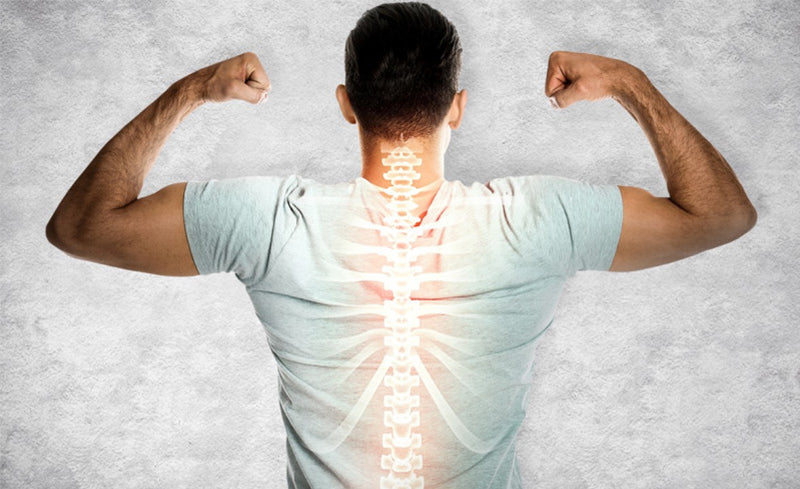
Being on your feet a lot, lifting heavy objects, and working and remaining in unnatural body postures is part of everyday life for many in the trades. It's no wonder that back pain and spinal disorders are among the main reasons for work absences. In a large number of cases, it involves muscular tension caused by one-sided strains. But damage to the spine is also common.
Especially when lifting and carrying, the greatest load is on the spine; during movement, it equally affects the intervertebral discs. If we lift or carry "incorrectly", the pressure is unevenly distributed on the intervertebral discs, which can lead to deformation over time. In the worst case, they can shift and press on the nerves in the spinal canal or – even worse – lead to a herniated disc.
Lifting – but correctly
The term "incorrect" lifting refers to lifting weight with a rounded back. Depending on the posture, enormous forces act on the spine, especially in the lumbar region, which can cause damage.
"Correct" lifting is done from the legs. The load should be positioned as directly in front of or between the feet as possible, the back kept straight, and the buttocks pushed back. The knees should not be bent more than 90°. By straightening the knee and hip joints, the load can now be lifted (or set down). Important: the movement should be conscious and fluid, and not jerky at all!
In movement, it is now important to keep the body upright and not to fall into a hollow back. This is best achieved when the load is carried close to the body – this can be supported by aids such as carrying straps, etc. A wheelbarrow – if available – can also help here.
Standing – but correctly
At least as important as "correct" lifting is the correct stance – especially when prolonged standing is required. To stand "correctly" and relieve the back as much as possible, both feet should be firmly on the ground and equally loaded. It should also be noted that the knees are slightly bent and the pelvis and chest are aligned vertically. This is best achieved when there is a certain basic tension in the body: pull in the stomach, pull the shoulders back, and tighten the buttocks.
Admittedly, the "correct" stance is initially tiring and requires some practice – this simultaneously trains the muscles and automatically leads to better posture.
Stay dynamic
If the body remains in an unnatural position for a long time, it can lead to tension in the back muscles. Hard and tense muscles can then irritate neighboring nerves and cause pain. Keeping the back warm and staying active can help prevent muscle tension.
Regular exercise (even in everyday life), targeted exercises to strengthen the back, abdominal, and leg muscles, as well as healthy sleep on a mattress tailored to the individual needs of the body, can also help keep the back strong and healthy.







Leave a comment
This site is protected by hCaptcha and the hCaptcha Privacy Policy and Terms of Service apply.