
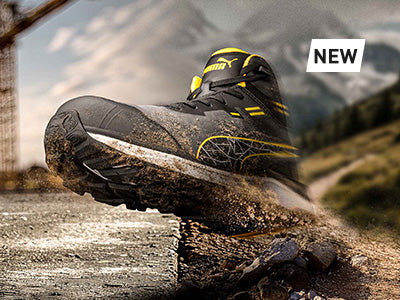
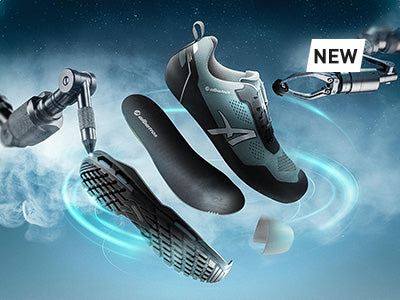
Safety shoes have high requirements to meet and must be able to withstand great loads. They are therefore subject to a standard that defines the basic requirements for safety shoes and the individual protection classes: The EN ISO 20345:2011. It regulates the high standards for safety shoes with toe protection for high loads, which provide protection against impact forces with an energy of up to 200 Joules and resist crushing with up to 15,000 Newtons.
The Basic Requirements
The basic requirements (SB) include
- Tensile strength of the upper material
- Strength of the upper material
- Water-repellent properties of the shoe upper
- Thickness of the upper material
- Abrasion resistance
- Bending behavior of the outsole
- Fuel resistance of the outsole
Safety shoes of class SB (Safety Basic) can have an open heel area.
Suitable for use in dry areas: Safety shoes of protection classes S1 and S1P
Safety shoes of safety class S1 have, in addition to the basic requirements (SB), a closed heel area. This improves the stability and support of the foot in the shoe.
- Antistatic
- Energy absorption capacity in the heel area and
- a gasoline and oil resistant outsole
are further required properties of S1 safety shoes. They are designed with optimized cushioning properties for long wearing times and are gentle on joints, ligaments, and tendons.
Safety shoes of safety class S1P also possess all the properties of safety shoes of safety class S1, supplemented by a puncture protection. It prevents the penetration of sharp objects through the sole (e.g., nails).
Shoes of both safety classes are excellent for use in the dry area.
Suitable for use in wet areas: Safety shoes of classes S2 and S3
Safety shoes of classes S2 and S3 are suitable for use in wet areas. Safety class S2 combines the same properties as S1, with additionally water-repellent upper materials, but without puncture protection.
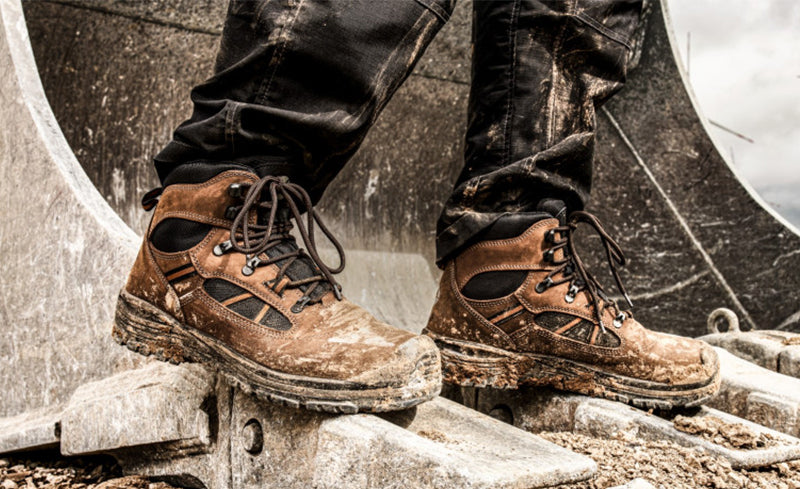
Shoes of the S3 classification, on the other hand, have a puncture protection and a strongly profiled outsole. They additionally protect against the penetration of sharp objects through the sole and provide very good support and slip resistance, even in demanding work environments, such as on construction sites and outdoors.
Differences within the S3 classification: S3L and S3S
Safety shoes of protection class S3L and S3S meet the requirements of class S3. While S3L-safety shoes additionally have a textile insole that has been subjected to a test with a 4.5-millimeter test nail, S3S-safety shoes not only have a textile sole that can withstand a 3-millimeter test nail, but also a water-repellent upper material.







Leave a comment
This site is protected by hCaptcha and the hCaptcha Privacy Policy and Terms of Service apply.